If you had to pick one single number that predicted your risk of heart disease, cognitive decline, cancer mortality, and overall longevity — what would you guess?
Cholesterol? Blood pressure? Body weight?
The answer, according to decades of peer-reviewed research, is VO2 max.
And yet, most people have never had it tested. Most doctors never bring it up. And most fitness programs completely ignore it.
That changes today. In this article, we’ll break down exactly what VO2 max is, why the science behind it is so compelling, what a low number means for your health, and — most importantly — what you can do about it.
What Is VO2 Max?
VO2 max — or maximal oxygen uptake — is the maximum rate at which your body can consume and utilize oxygen during intense exercise. It’s expressed in milliliters of oxygen per kilogram of body weight per minute (mL/kg/min).
In plain terms: it measures how efficiently your cardiovascular system, lungs, and muscles work together to produce energy. The higher your VO2 max, the more oxygen your body can process — and the harder and longer you can sustain physical effort before fatiguing.
But here’s what most people don’t realize: VO2 max isn’t just a fitness metric. It’s a window into the health of your entire metabolic and cardiovascular system — and its predictive power extends far beyond athletic performance.
“Low cardiorespiratory fitness — measured by VO2 max — is responsible for more deaths annually than smoking, obesity, hypertension, and diabetes combined.” — Journal of the American Medical Association
Why VO2 Max Predicts Longevity
The research on VO2 max and lifespan is extensive, consistent, and striking. Here’s what the data shows:
One of the most widely studied measures of cardiorespiratory fitness and is associated with long-term health outcomes.
A landmark study published in JAMA Network Open (2018) followed over 122,000 patients over a decade. The study found that individuals with low cardiorespiratory fitness had a dramatically higher risk of death from all causes — comparable to or exceeding risks associated with smoking, hypertension, and diabetes. Critically, there was no upper limit identified — the researchers observed an association between higher cardiorespiratory fitness and lower mortality risk across the study population.
It’s closely associated to cardiovascular health
Your heart is a muscle, and VO2 max is one of the most direct measures of how well your cardiovascular system functions under stress. Low VO2 max is associated with higher rates of coronary artery disease, heart failure, and stroke. In fact, research has found that higher cardiorespiratory fitness is associated with a lower risk of cardiovascular mortality.
It correlates with cognitive health and dementia risk
The brain requires a constant, efficient supply of oxygenated blood. Studies from the Norwegian University of Science and Technology and other research has found that higher VO2 max is associated with measures of cognitive health, including executive function, and may be associated with a lower risk of cognitive decline. Researchers believe this relationship may be related, in part, to healthy blood flow supporting normal brain function.
Research has explored the relationship between VO2 max and cancer outcomes.
Some studies have found an association between higher pre-diagnosis VO2 max and favorable outcomes among certain groups of cancer patients. Researchers continue to study the biological mechanisms underlying these observations.
VO2 max naturally declines with age but regular training can help maintain it.
VO2 max naturally declines approximately 10% per decade after age 30 in sedentary individuals. However, research suggests that regular endurance training and physical activity may help slow the natural age-related decline in VO2 max.. Maintaining cardiorespiratory fitness over time is associated with healthier aging and long-term physical function.
What’s a “Good” VO2 Max? Understanding the Numbers
VO2 max values vary by age and sex. Here’s a general reference for adults:
Men (ages 40–49):
- Below 33.0 — Poor (significantly elevated risk)
- 33.0–38.9
- 39.0–43.7
- 43.8–48.0
- Above 48.0 — Excellent (associated with strong longevity outcomes)
Women (ages 40–49):
- Below 26.0 — Poor
- 26.0–31.4
- 31.5–35.6
- 35.7–40.0
- Above 40.0 — Excellent
You don’t need to be an elite athlete. Even modest improvements in cardiorespiratory fitness can have meaningful health benefits.
Many patients we evaluate on Long Island have VO2 max values that fall within closer to poor range, including some who exercise regularly. This highlights the importance of measuring cardiorespiratory fitness rather than relying on exercise habits alone.
How Is VO2 Max Measured? The PNOE Test Explained
There are several ways to estimate VO2 max — wearables, age-based formulas, submaximal exercise tests — but these are estimates, often with significant error margins. Direct metabolic assessment using a metabolic cart is considered one of the most comprehensive methods for measuring VO2 max and is the approach we use at Ascent Wellness with the PNOĒ system.
How the PNOE Test Works
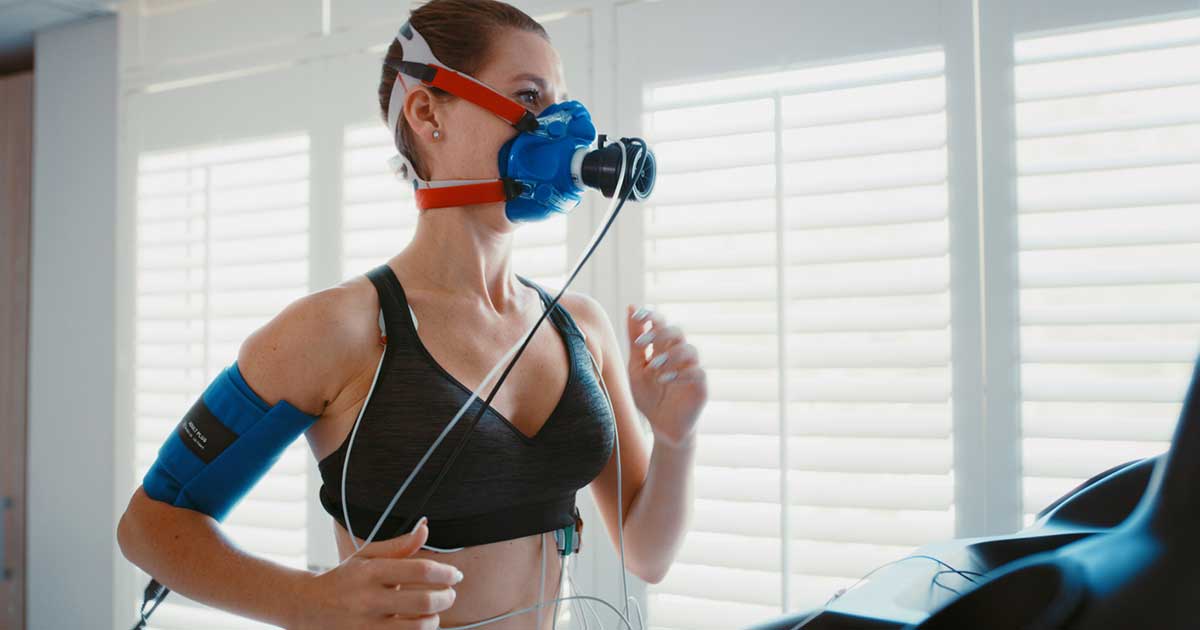
The PNOE test is a breath-by-breath metabolic analysis conducted while you exercise at progressively increasing intensity. Here’s what happens:
- You wear a lightweight mask connected to the PNOE analyzer
- You begin exercising (typically on a stationary bike or treadmill) at a low intensity
- Every 3 minutes, the intensity increases in a standardized protocol
- The system continuously measures the oxygen you inhale and carbon dioxide you exhale
- The test reaches your maximum effort point — and that data allows us to directly measure your VO2 max.
The entire test takes approximately 10–20 minutes. Your results are available shortly after the assessment and reviewed with you by our team.
What the PNOE Report Includes
Beyond your VO2 max measurement, the PNOĒ assessment provides information about:
- Your resting metabolic rate (RMR), estimating the calories your body burns at rest to help inform nutrition planning.
- Your fat-utilization zone, identifying the heart rate range associated with efficient fat metabolism during exercise.
- Your aerobic and anaerobic thresholds, helping guide personalized training recommendations.
- Your respiratory exchange ratio, showing how your body utilizes fats and carbohydrates at different exercise intensities.
- Measures that provide insight into cellular energy metabolism.
These results provide objective information that can help guide personalized exercise, nutrition, and lifestyle recommendations based on your individual physiology.
Supporting Your VO2 Max
VO2 max can respond to regular training at many stages of life. Below are several research-supported approaches commonly used to support cardiorespiratory fitness.
1. High-Intensity Interval Training (HIIT)
HIIT is a well-studied training approach that may help support improvements in VO2 max. Research suggests that 2–3 sessions per week of interval training performed at higher exercise intensities may support improvements in VO2 max when incorporated into an appropriate training program. The appropriate training intervals depend on your aerobic and anaerobic thresholds, which can be assessed during your PNOĒ evaluation.
2. Zone 2 Aerobic Training
Despite the enthusiasm for high-intensity work, Zone 2 training — sustained, moderate-intensity cardio at 60–70% of max heart rate —helps develop aerobic fitness and supports higher-intensity exercise. Elite endurance athletes spend roughly 80% of their training time in Zone 2. For most adults, 3–4 hours of Zone 2 per week may support aerobic fitness, mitochondrial function, and fat utilization over time.
3. Hormone Therapy
When clinically appropriate, hormone therapy may be considered as part of a comprehensive treatment plan. Hormone levels can influence energy metabolism, exercise capacity, and overall physical function, which is why they are included in a comprehensive evaluation.
4. Peptide Therapy
When clinically appropriate, peptide therapy may be considered as part of a comprehensive plan that also includes exercise, nutrition, and lifestyle recommendations. Certain peptide protocols are being studied for their potential role in supporting mitochondrial function and exercise performance.
5. Metabolic Nutrition Protocols
Nutrition plays an important role in supporting exercise performance and cardiorespiratory fitness. Based on your RMR and fat-burning zone data from the PNOE test, using information from your PNOĒ assessment, including your resting metabolic rate and exercise data, we develop personalized nutrition recommendations tailored to your training goals and overall health.
Why VO2 Max May Not Improve Despite Regular Exercise
ome individuals exercise regularly yet see little change in their VO2 max over timee at Ascent Wellness: patients who have been exercising consistently for years — going to the gym, running, taking classes — and yet their VO2 max remains stagnant or continues to decline.
Why? Several reasons:
- Training intensity may not always align with the individual’s current fitness level or goals.
- Hormone levels may influence exercise performance and adaptation in some individuals.
- Metabolic health may influence cardiorespiratory fitness and exercise capacity.
- Sleep, nutrition, and recovery are important components of any training program.
This is precisely why testing matters. Objective testing can provide information that helps personalize exercise and nutrition recommendations. With that data, every session has a specific purpose and a measurable target.
Find Out Where You Stand — VO2 Max Testing on Long Island
At Ascent Wellness in Syosset, we offer PNOE VO2 max, and metabolic testing as part of our comprehensive Ascent Wellness evaluation. In a single session, you’ll know:
- Your measured VO2 max and what it means for your longevity risk
- Your measured resting metabolic rate — not an estimate
- Your individualized training zones
- Personalized exercise, nutrition, and lifestyle recommendations based on your assessment results.
Whether you’re 35 and focused on physical performance, or 58 and looking to better understand your metabolic health, PNOĒ testing provides valuable information to help guide your next steps.
Make informed decisions about your health with objective data and physician-guided insights
Book your Ascent Wellness PNOĒ Test and gain personalized insights into your metabolic health and exercise performance.
Book My VO2 Max Test at Ascent Wellness